Quick answer: the sound your car makes when you turn the key or press the start button tells you where to look. Rapid clicking usually means a weak or dead battery. Normal cranking but no start points to fuel, spark or the immobilizer. Complete silence suggests a dead battery, loose battery terminals, the car not being in Park or Neutral, or a starter problem.
Diagnose by Symptom
| What happens | Likely causes |
|---|---|
| Rapid clicking, dash lights dim | Weak or dead battery, corroded or loose terminals |
| Single loud click, no crank | Starter motor or starter solenoid, poor connection |
| No sound, no lights | Completely dead battery, disconnected battery cable |
| No sound, lights work | Not in Park/Neutral, faulty starter or ignition switch, blown fuse |
| Cranks normally but will not start | Empty fuel tank, fuel pump, ignition problem, immobilizer/key issue |
| Starts, then dies right away | Immobilizer not recognizing the key, fuel delivery or idle problem |
Quick Checks Before You Call for Help
- Check the lights. Turn on the headlights. If they are dim or do not come on, the battery is the likely problem.
- Check the gear selector. Automatics only start in Park or Neutral. Move the lever firmly into Park and try again.
- Check the steering lock. If the key will not turn, wiggle the steering wheel while turning the key.
- Check the key fob. For push-button starts, a weak fob battery can stop the car recognizing the key. Most cars let you hold the fob against the start button. Check your owner’s manual for the exact spot.
- Check the fuel gauge. It sounds obvious, but an empty tank is a common cause of cranking with no start.
- Check the battery terminals. White or green corrosion, or a loose clamp, can stop the starter getting enough current.
How to Jump Start a Car Safely
- Park the working car close by and switch both engines off.
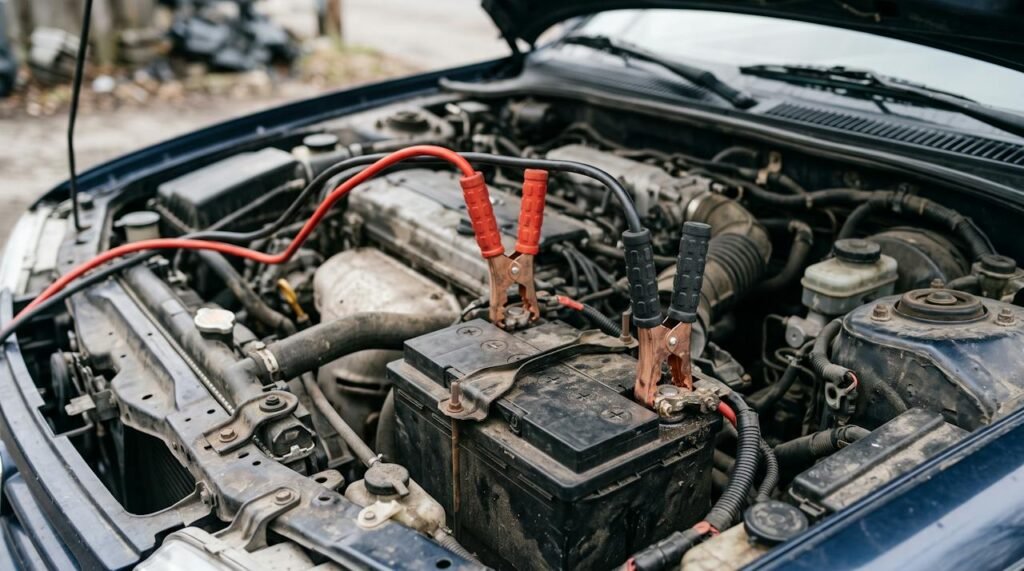
- Connect the red cable to the dead battery’s positive (+) terminal, then to the good battery’s positive terminal.
- Connect the black cable to the good battery’s negative (–) terminal, then to a bare metal point on the dead car’s engine, away from the battery.
- Start the working car and let it run for a few minutes, then try to start the other car.
- Remove the cables in reverse order.
If the car starts with a jump but will not start again later, the battery may be failing to hold a charge, or the alternator may not be charging it. A parts store or garage can test both.
Frequently Asked Questions
How do I know if it is the battery or the starter?
A weak battery usually gives rapid clicking and dim lights, and a jump start fixes it. A bad starter usually gives a single click or no sound, while the lights stay bright, and a jump start does not help.
Why does my car start fine sometimes but not others?
Intermittent problems are often caused by loose or corroded battery connections, a failing starter, or a fuel pump on its way out. Note the conditions when it fails (hot, cold, after a short trip) to help your mechanic.
Can cold weather stop a car from starting?
Yes. Cold weather reduces battery power and thickens engine oil, so a battery that is already weak often fails on the first cold morning.